
How to Build, Backtest, and Refine a Crypto Trading Strategy with AI
Mar 12 | 7 Mins MIN | Kvants Studio
By
Kvants Team


How to Build, Backtest, and Refine a Crypto Trading Strategy with AI
Crypto markets run continuously, but a strategy still needs explicit rules. “Buy when momentum is strong” is an idea, not yet a system. A testable strategy defines the market, timeframe, signal, entry timing, exits, position sizing, and risk limits.
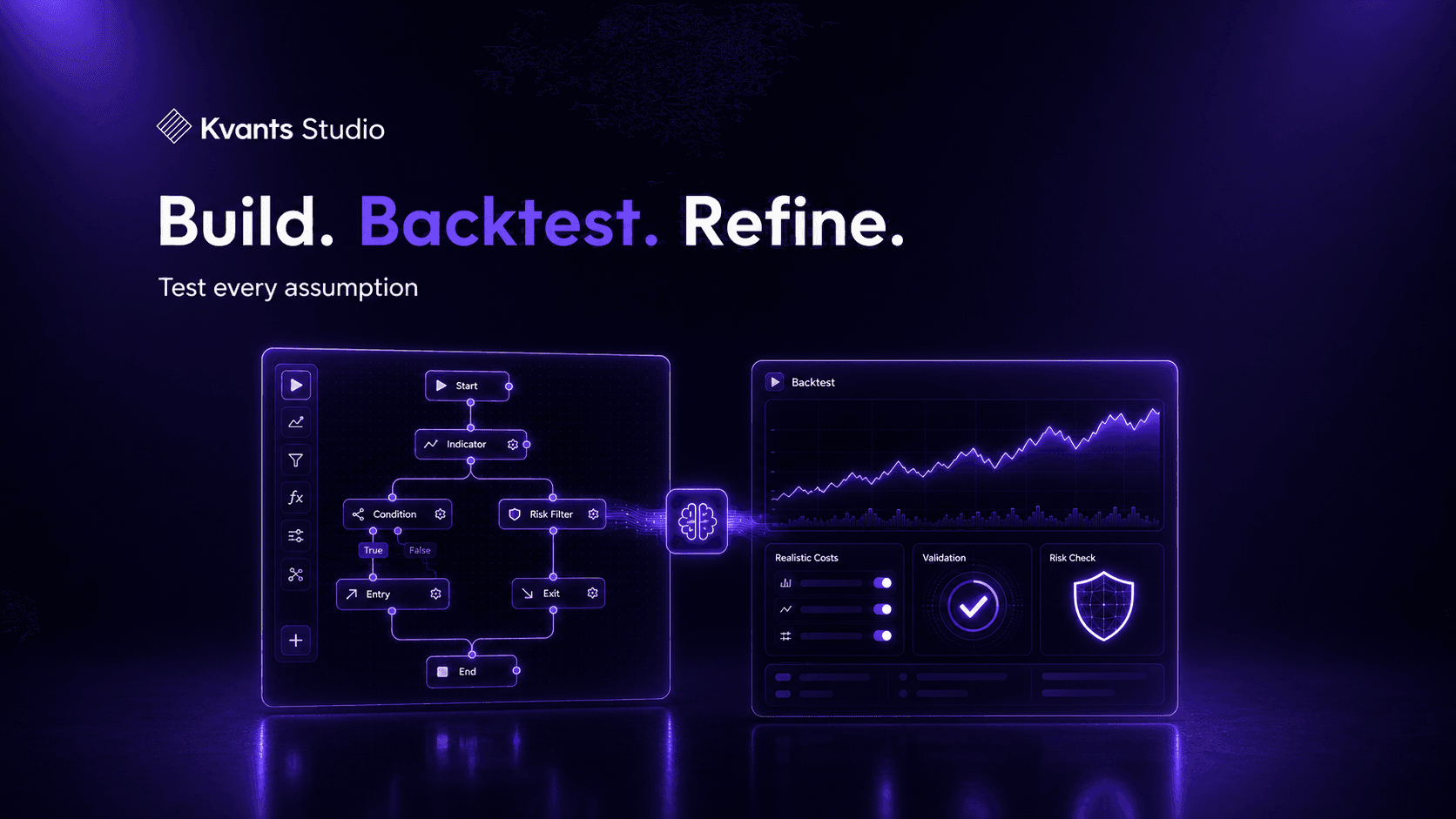
Kvants Studio helps you turn those details into a transparent strategy without writing code. Describe the idea in plain English, inspect the AI-generated graph, backtest it with realistic assumptions, and refine the rules before considering paper trading or deployment.
Begin with a falsifiable hypothesis
Start with a statement that historical data can challenge. For example:
“On BTC-USD daily bars, enter long when price closes above its 200-day moving average and 30-day momentum is positive. Exit when price closes below the moving average or a volatility-based stop is reached. Risk no more than 0.5% of account equity per trade.”
This description identifies the instrument, frequency, signal, exit, and risk budget. Kvants Studio can draft the corresponding strategy graph and surface missing choices such as order timing or warm-up periods.
Review the generated graph
AI is useful for translating intent, but it should not hide the rules. Kvants Studio expresses the strategy as connected nodes for data, indicators, conditions, entries, exits, sizing, and risk controls.
Read the graph as if you were reviewing someone else’s model. Does the entry use information that was actually available at the time? Is a crossover evaluated on the close and executed on the next bar? Can more than one position be open? What happens during missing data or sudden volatility?
Making these assumptions visible is one of the most valuable parts of the workflow.
Backtest with realistic costs
A backtest should simulate the strategy you could have run, not an idealized version of it. Include trading fees and slippage. For perpetual futures, account for funding where relevant. Confirm that signals and orders are aligned to the correct timestamps.
Then examine the whole distribution of outcomes. Useful questions include:
How large and how long were the drawdowns?
Did a small number of trades drive most of the result?
How sensitive is the result to slightly different parameters?
Does the idea behave similarly across different market regimes?
What changes when costs or execution assumptions become less favorable?
Kvants Studio’s backtesting workspace is built to help you inspect trades and risk metrics, not just a single return number.
Refine without curve-fitting
Plain-English iteration makes experimentation faster. You might ask Kvants Studio to add a volatility filter, cap position size, compare a trend exit with a time-based exit, or run the same logic across multiple assets.
Speed creates a new responsibility: avoid tuning until historical results look perfect. Keep an out-of-sample period, limit the number of changes you make, and prefer rules that remain understandable and robust under small variations.
A simpler model with stable behavior is often more useful than an elaborate one designed around a particular historical path.
Use paper trading as another test
Historical testing cannot reproduce every live condition. Paper trading can reveal delayed data, order timing, liquidity, and state-management problems. Treat it as a separate validation stage, not as proof that future performance will match the past.
Kvants Studio supports a controlled path from idea to graph, backtest, and paper trading. Where supported, you can also export the strategy as Pine Script or a Kvants strategy file for further review and use.
You stay in control
Kvants Studio is an AI trading strategy builder, not an asset manager or managed crypto fund. It does not promise returns and it does not replace your judgment. The AI accelerates the translation and research workflow; you decide which rules to accept, which tests to run, and whether a strategy should move beyond research.
A good first project is narrow: one market, one timeframe, one entry concept, one exit concept, and a conservative risk rule. Describe it in plain English, inspect every node, and let the evidence—not the narrative—guide the next iteration.
Backtests and simulations are hypothetical and do not guarantee future results. Kvants Studio provides strategy-building and research tools, not personalized investment advice.

Read more